Report No. 01 · 2026
Sequoia, a Database from the Page Up
A disk-based relational database in Rust with zero dependencies — pages, a write-ahead log, three storage engines and a Volcano executor — written to be read, not to be fast.
Why
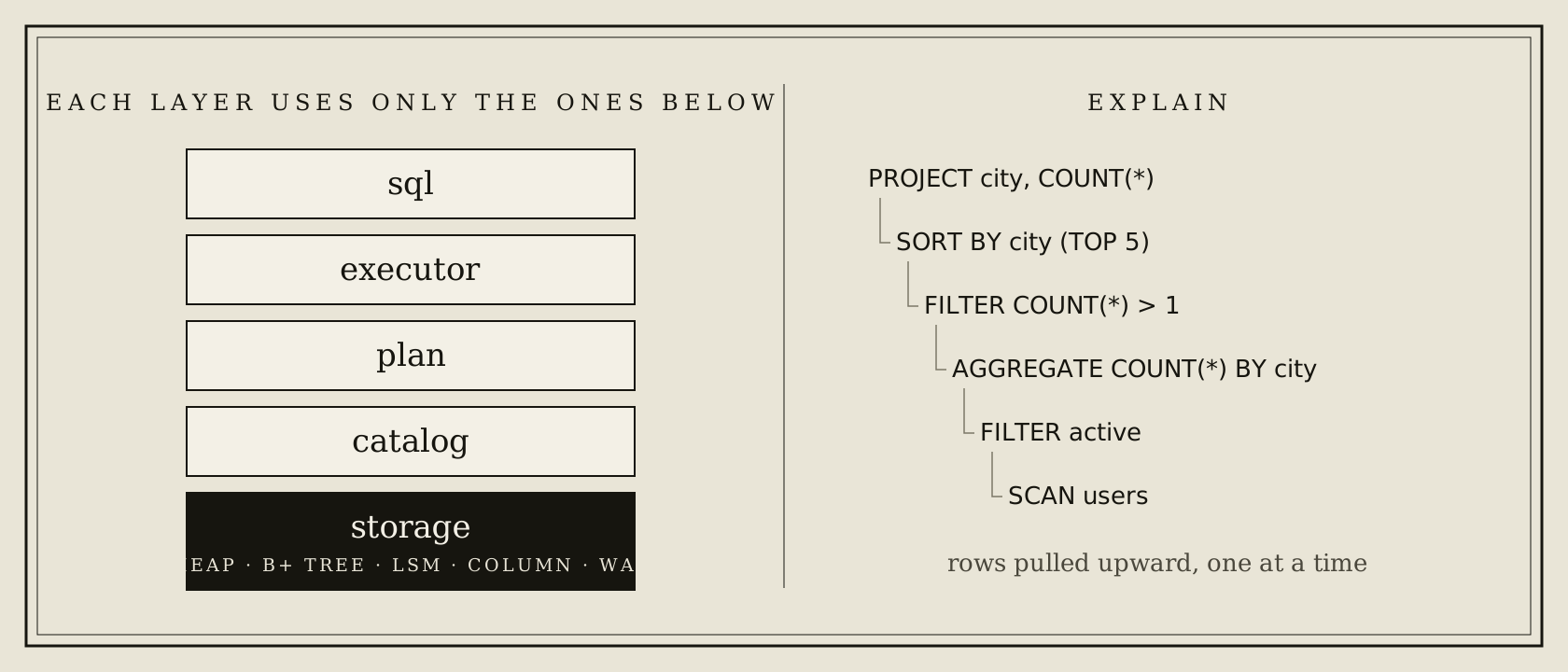
Every layer of a database is described somewhere in a textbook, but the textbook rarely shows where one layer hands off to the next. Sequoia is the whole path in one small codebase: SQL text goes in at the top, 4 KB pages come out at the bottom, and each layer uses only the ones below it. There are no dependencies, so nothing is hidden behind a crate.
What is in it
- The language. A hand-written lexer and recursive descent parser.
Joins (inner, left, cross),
GROUP BY/HAVING,DISTINCT,ORDER BY,LIMIT, and correlated, nested subqueries, with SQL’s three-valued logic forNULL. - Planning.
WHEREandONare split at theirANDs and pushed down to the scan that can use them, where they pick an index. Each join is an index join, a hash join or a nested loop, in that order of preference.EXPLAINprints the tree. - Execution. Volcano style: every step is an iterator pulling rows from
the one below, so a
LIMITstops the scan once it has enough. Sorting spills to an external merge sort past its memory budget, and becomes a top-N heap under aLIMIT. - Three storage engines. A slotted-page heap, the default; an LSM tree with a skip-list MemTable, Bloom filters and level or universal compaction; and a PAX column store whose chunks pick their own encoding (run-length, bit-packing, delta, dictionary, bitmap) and are filtered while still compressed.
- Indexes. B+ trees with splits, merges and linked leaves, over one column of a heap or LSM table.
- Durability. A buffer pool with ARC replacement (LRU-K and CLOCK too), and a write-ahead log of checksummed page frames. Every statement is atomic, transactions have savepoints, and recovery keeps exactly the frames up to the last valid commit.
How it is checked
Crash tests run every kind of statement on simulated files that stop at an arbitrary write, then check that every table and index shows the statement entirely or not at all. A differential test generates random schemas, rows, queries and transactions, runs them on both Sequoia and SQLite, and fails — printing the case as a script for the shell — the moment the two disagree.
Status
Small and easy to read, not fast. One connection, so no concurrency control;
no RIGHT or FULL joins, no multi-column indexes.